Nobody Knows Anything

Welcome to Diane Patterson's eclectic blog about what strikes her fancy

Evidence of the consumer society

Posted on February 7, 2005 Written by Diane

So, it turns out I did, in fact, break the KitchenAid mixer: I started it up today and the motor started but the paddle didn’t. I looked on the KitchenAid site for the nearest authorized repair place and called them. When I described the problem, the woman who answered the phone said, “Well, it could be anything from Such-and-such, which costs about sixty dollars, to This-and-so, which is about hundred. That’s what you’re looking at. And it’ll be about a week.”

A new mixer costs $250. And I have it tomorrow.

Now, it so happens that at the moment (hello there, first of the year) things are a little tighter and spending $60 on something is vastly preferable to spending $250 on it. But still: it’s something to consider, isn’t it? Get a wholly new mixer, fresh warranty and everything, for somewhere between two and four times what it would cost to fix the old one. And who fixes these things, anyhow? Just get a new one! Move on, move up! Consume! It’s not that much money! You can get something totally new!

Maybe if I had used the mixer day-in and day-out for the past few years and it had busted like this I’d say, Yeah, time for a new one. But it’s hardly ever been used, and I managed to blow it out doing something stupid. Hardly seems fair to reward myself with a new mixer, no?

The appliance repair place is over by the kids’ school, so I can drop off the mixer after I drop off the kids.
Share this:

  • Click to email a link to a friend (Opens in new window)
  • Click to print (Opens in new window)
  • Click to share on Twitter (Opens in new window)
  • Click to share on Facebook (Opens in new window)
  • Click to share on Reddit (Opens in new window)

Filed Under: All About Moi

Baking By Flavor: the review

Posted on February 6, 2005 Written by Diane

I got Baking By Flavor by Lisa Yockelson (which I heard about because it was recommended early and often by Zarah at Food & Thoughts) out of the library today and brought it to the park to read while the kids played and Darin recovered from tandem-bicycling with Sophia. Before I had a chance to read it, though, I had to go do something with the kids; Darin picked up the book to flip through it. When I returned he looked up at me and said,

You need to buy this book immediately.

So, just in case you’re looking for a really good cakes, pies, pastries, and cookies book? Evidently this would be one.

Share this:

  • Click to email a link to a friend (Opens in new window)
  • Click to print (Opens in new window)
  • Click to share on Twitter (Opens in new window)
  • Click to share on Facebook (Opens in new window)
  • Click to share on Reddit (Opens in new window)

Filed Under: Books and Magazines, Cooking and Food

Baking some bread

Posted on February 6, 2005 Written by Diane

Tamar has always liked to bake her own bread, but I’ve always pictured it as being labor-intensive: standing there for hours (I thought it took hours, honestly) kneading this batch of dough, really working those forearm muscles, never getting out of the kitchen…

But we have this KitchenAid mixer; wasn’t that supposed to help in some way? Oh yes, here it is, right in the recipe: use heavy-duty mixer. I walked over to Sur La Table—yes, virtuous me, walking to the cooking store so I could buy the materials to make homemade bread!—where I bought a baking stone that was on clearance (and a good thing I got that one, because it was 15″ in diameter and the regular one was 16″, which would not have fit) and two 8 1/2 by 4 1/2 inch loaf pans. There were nonstick loaf pans for $14.95 and basic steel pans for $2.50. I asked the clerk, Is there any difference between these? “Well, I guess you’ll have to grease those pans,” she said of the plain steel ones. Twelve bucks of greasing per pan, yeah, I can handle that.

I assembled my materials, made my initial yeast mixture, got elements into the KitchenAid mixing bowl, attached dough hook, began mixing and kneading. After 10 minutes of kneading, though, the KitchenAid just stopped. I turned it off and back on; the dough hook started to turn, and then the machine kind of whined at me. I cleaned off the bits of stray dough, unplugged it, replugged it…nothing doing. I felt the top of the mixer body: very hot.

Hmmm. That’s not supposed to happen, is it?

Apparently not, but it did to me. I assume I did something wrong (well, beyond the first mistake, which was not putting on the plastic petticoat around the top of the mixing bowl; flour covered a two-foot radius around the KitchenAid). When the mixer cooled down, I turned it on again, and the arm turned, no problem.

How I overheated it on a simple white bread dough, I have no idea. But congratulations to me! I ended up kneading the butter into the dough for the last two minutes. So I worked those forearms anyhow.

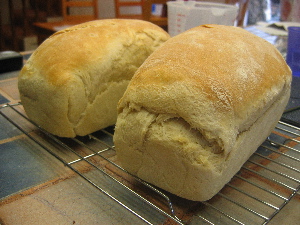
bread.jpg

Looks pretty okay, doesn’t it? Especially for a first try. I did not get the kitchen-full-of-bread smell I was hoping for, but that’s okay. Not just cute, these were also pretty good bread. (Not the superlative, transcendent experience I was hoping for, but, you know: KitchenAid disaster.)

I have several bread recipes I could have used, but I chose the one from Baking With Julia.

Makes two 1 3/4-pound loaves

2 1/2 cups warm water (105F to 115F)
1 tablespoon active dry yeast
1 tablespoon sugar
7 cups (approx.) bread flour or unbleached all-purpose flour
1 tablespoon salt
2 oz. unsalted butter (1/2 stick), at room temperature

Pour 1/2 cup of the water into the bowl of a heavy-duty mixer, sprinkle in the yeast and sugar, and whisk to blend. Allow the mixture to rest until the yeast is creamy, about 5 minutes.

Working in the mixer with the dough hook in place, add the remaining 2 cups water and about 3 1/2 cups flour to the yeast. Turn the mixer on and off a few times just to get the dough going without having the flour fly all over the counter and then, mixing on low speed, add 3 1/2 cups more flour. Increase the mixer speed to medium and beat, stopping to scrape down the bowl and hook as needed, until the dough comes together. (If the dough does not come together, add a bit more flour, a tablespoon at a time.) Add the salt and continue to beat and knead at medium speed for about 10 minutes, until the dough is smooth and elastic. If you prefer, you can mix the dough in the machine for half that time and knead it by hand on a lightly floured surface for 8 to 10 minutes. When the dough is thoroughly mixed (return it to the mixer if necessary), add the butter, a tablespoon at a time, and beat until it’s incorporated. Don’t be disconcerted if your beautiful dough comes apart with the addition of butter—beating will bring it back together.

First Rise: Turn the dough out onto a lightly floured work surface and shape it into a ball. Place it in a large buttered or oiled bowl (one that can hold double the amount of dough). Turn the dough around to cover its entire surface with butter or oil, cover the bowl tightly with plastic wrap, and let the dough rest at room temperature until it doubles in bult, about 45 minutes to 1 hour.

Shaping the Dough: Butter two 8 1/2 by 4 1/2 inch loaf pans and set them aside.

Deflate the dough and turn it out onto a lightly floured work surface. Divide the dough in half and work with one piece at a time. Using the palms of your hands and fingertips, or a rolling pin, pat the dough into a large rectangle about 9 inches wide and 12 inches long, with a short side facing you. Starting at the top, fold the dough about two thirds of the way down the rectangle and then fold it again, so that the top edge meets the bottom edge. Seal the seam by pinching it. Turn the roll so that the seam is in the center of the roll, facing up, and turns the ends of the roll in just enough so that it will in a buttered loaf pan. Pinch the seams to seal, turn the loaf over so that the seams are on the bottom, and plump the loaf with your palms to get an even shape. Drop the loaf into the pan, seam side down, and repeat with the other piece of dough.

Second Rise: Cover the loaves with oiled plastic wrap, and allow them to rise in a warm place (about 80F) until they double in size again, growing over the tops of the pans, about 45 minutes.

While the loaves rise, center a rack in the oven and preheat the oven to 375F.

Baking the Bread: When the loaves are fully risen (pokeyour finger into the dough; the impression should remain), bake them for 35 to 45 minutes, or until they are honey-brown and an instant-read thermometer plunged into the center of the bread (turn a loaf out and plunge the thermometer through the bottom of the bread) measures 200F. (If you like, 10 minutes or so before you think the loaves should come out, you can turn the loaves out of their pans and let them bake on the oven rack so they brown on the sides.) Remove the loaves from their pans as soon as they come from the oven and cool the breads on racks. These should not be cut until they are almost completely cool; just-warm is just right.

Storing: Once completely cool, the breads can be kept in a brown paper bag for a day or two. Once a loaf is sliced, turn it cut side down on the counter or a cutting board and cover with a kitchen towl. For longer storage, wrap the breads airtight and freeze for up to a month. Thaw, still wrapped, at room temperature.

Contributing Baker Craig Kominiak

At first Sophia didn’t want to eat any of the homemade bread, insisting on store-bought. But then Darin got her to try it, and the four of us have managed to eat most of the two loaves I made this weekend. So homemade bread appears to be a hit! Sophia is very interested in making baguettes (or, as she calls them, “long brrrread”—she trills her r’s like a Castillian grandee; it’s quite cute), so maybe that will be our next project together.

I sure hope I don’t have more problems with the KitchenAid though, because I am not kneading by hand. No, sorry. My virtuosity has firm limits.

Share this:

  • Click to email a link to a friend (Opens in new window)
  • Click to print (Opens in new window)
  • Click to share on Twitter (Opens in new window)
  • Click to share on Facebook (Opens in new window)
  • Click to share on Reddit (Opens in new window)

Filed Under: Cooking and Food

  • « Previous Page
  • 1
  • …
  • 235
  • 236
  • 237
  • 238
  • 239
  • …
  • 385
  • Next Page »

Search

Recent Comments

  • Nina: I love that you have footnotes for you blog post.
  • John Steve Adler: I reread it now that you are published. I still like it! It’s great to have so many loose...
  • Diane: Holy moly! I haven’t heard the term “tart noir” in a long time! I looooved Lauren...
  • Merz: “My main problem with amateur sleuths is always they’re always such wholesome people. How on Earth do...
  • Diane: 1) I’ll have to give Calibre another try for managing Collections. Do you know of a webpage with good...

Copyright © 2026 · Focus Pro Theme on Genesis Framework · WordPress · Log in