Software writers need

May 14

1. Scrivener

You know this. Just go and buy it already.

Lots of writers feel this way about it. If you do a web search on “scrivener is the best”, you get a lot of responses, all of which you can investigate on your own free time.

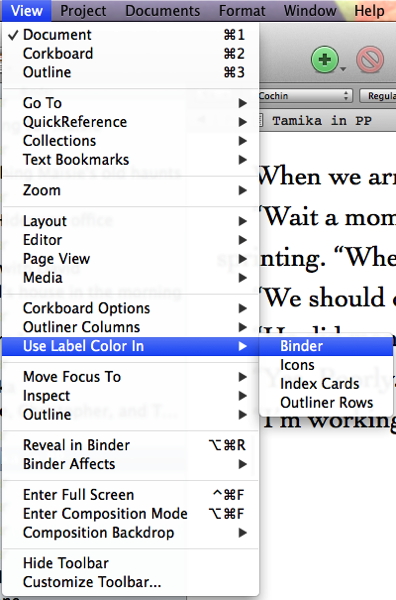
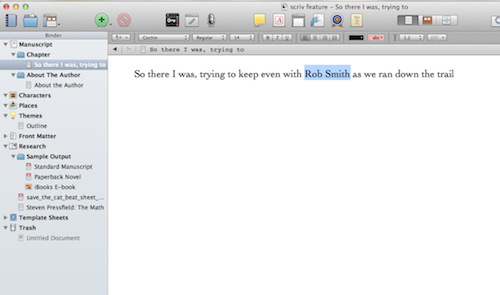
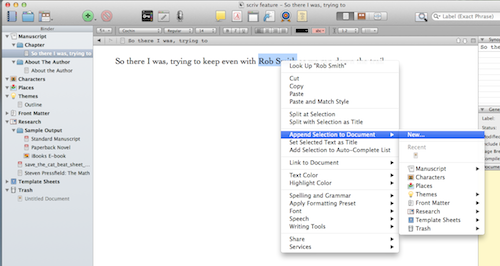
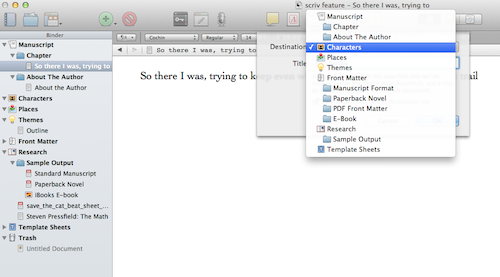
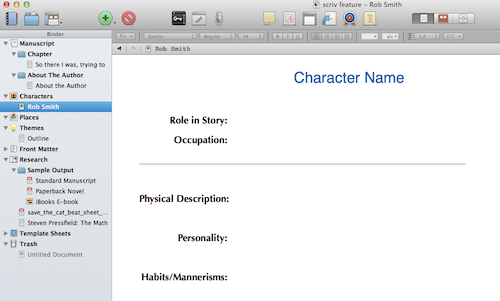
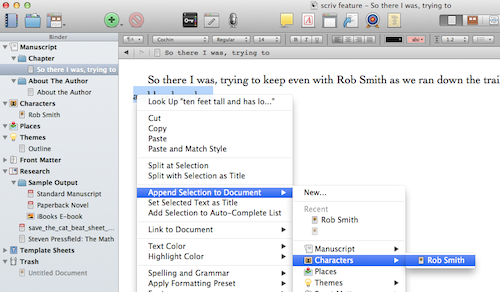
The short version: Word (or even Pages) is a word processor, most often used as a WYSIWYG layout tool — not as powerful as a dedicated layout application, but what you see on screen affects what comes out when you print. Scrivener is an application for writing: how you lay the text out on screen as you write has nothing to do with what comes out the other end. I just concentrate on the writing. I can have one file for my entire book. Or, I can have each chapter in a separate text file. Or, I can have folders represent each chapter, and multiple text files in each chapter folder. And I can easily navigate the entire book through the binder, which is the main window.

Index cards! Folders for all my research! Click-and-drag to rearrange entire chapters! FULL SCREEN! (Ulysses had this feature first, but Scrivener really did a boss job with it.)

When it comes to publishing books, Scrivener is even more awesome: with a little bit of work on your part, Scrivener can easily (and I do mean easily) generate .epub, .mobi, .pdf — whatever files you need. You don’t need to follow any tricky “nuclear option” formatting solutions. You don’t need to fight with Word’s problems with Kindle, which has led to some books having seriously messed up formatting. Scrivener puts it together for you. Don’t fight the power. Let the power work for you. 

2. Scapple

Well, okay, I’ll be honest: I haven’t used this much. Mindmapping isn’t a thing I’ve managed to make work for me yet. But I’m a total Scrivener fangirl and if it’s software from Scrivener’s developer, that’s good enough for me: shut up and take my money!

3. Aeon Timeline

Holy crap, I am finding this so useful. Aeon Timeline allows you to make a timeline (duh) using our known calendar or a custom calendar format that you set up (like, for a fantasy world). 

How am I using this? Well, I have one document named “Drusilla.” I have the General timeline, that has all of the events of her life, many of which I make up on the spot but then need to keep referring back to. I have the YKWIA timeline, which is a subset of the General timeline and has all of the events of that book written into it. I have the timeline for the new book: what happens when? 

Aeon Timeline figures out how old Drusilla and Stevie are for each of these events. It can calculate how long it’s been between events. I can keep track of locations, names, and length of time. Which characters were where at which time of their lives.

Until such time as I can hire an assistant to do nothing but comb my stuff for continuity, this will have to do.

4. WriteRoom

Distraction-free writing for iOS and Mac. Which means: no bells and whistles. Minimal styles. If I’m on the go somewhere, I can write in there and then use DropBox to transfer to my Mac, where I can pop the text into Scrivener easily. Other writers like iA WriterWriting Kit, or Daedalus (from the guys who brought you Ulysses).  

§

I have but don’t use Index Card for iOS, mostly because Scrivener has its own index card system. 

Any other software I ought to know about?

Read More

That interview

Mar 08

As promised… the interview my friend Michele Montgomery ran on her Facebook page last week. 

§

Michele: Diane… a traditional publisher has an experienced marketing team to design the novel. How does an author decide which images from the story to entice us with on the cover – knowing everyone judges a book by it?

Me: I consulted with my marketing team (which consists of: me) and said, What draws me in to investigate a book? Usually the genre (I like mystery), then the author (if I know the name), then the cover. Since this is my first book, no one’s going to know my name. I wanted a cover people would notice.

First things first: find a good cover artist.

I looked at the portfolio of a lot of artists and asked myself, “Would I pick up that book?” The artist I eventually worked with, Scarlett Rugers, had lots of books whose covers really jumped out at me. And she’s been fabulous to work with. She asked what I had in mind for the cover: styles, photos, etc. Then she read the book to pick out thematic elements.

She generated several very different possible covers, and the one that jumped out for me (and everyone I showed it to) was the one I eventually went with: an identity bracelet covered in blood. So now the reader has a mystery right away: whose bracelet is this?

Identity is a major theme in the book, so that worked out very well.

Patricia Burroughs*: I think that’s a really smart approach. Covers still matter to me, even on ebooks. Perhaps you can’t judge a book by its cover, but often with ebooks the care and thought given to a cover imply something about the care given to the writing and editing of the book.

Me: Particularly covers in thumbnail! You have to look at the covers in tiny as well.

Robert Gregory Browne**: Oh, and weighing in on the cover thing. A cover is your first impression. Don’t skimp on cover art. Don’t think you’ll just be able to whip something up in Paintshop Pro. Unless you’re a graphic designer, get a professional to handle it.

Marc Fine: I think that people do generally judge a book by its cover. I know that I do, when I’m browsing in library or bookstore.

Me: Seconding Robert Gregory Browne’s comments about covers, by the way: the cover is your first impression. Make sure it represents your book and looks professional.

§

Marc Reed: What is your process for naming your characters? Why Drusilla Thorne? Are they based on actual people people or randomselected from the phone book?

Me: Neither, actually — Drusilla is actually the latest of several fake names our heroine has had. The genesis of the name — and why she’s needed so many fake ones — are an integral part of how she got to be who she is now. (And how she ended up with such an over the top name says a lot about who she was when she picked it, the author said hintingly.  :) )

Michele Montgomery: Marc Reed… do you really think there’s a Drusilla Thorne in a phone book outside the U.K.? 

Marc Reed: How would I know if Diane wasn’t in the UK at some point in time? And Thorne looks very much like Thome – which it kinda resembles on my screen because I’m overdue for an eye exam.

§

Robert Gregory Browne: Where do you get your ideas? If I pay you, can I have some of them? How many pages do you write per minute? How many books per week? Okay, I’m done being an asshole now. I wish you great luck with the book Diane! Tell us when and where we can buy.

Me: When I get an idea, I think, “Is this something Robert Gregory Browne would write?” If the answer is no, then I feel pretty confident I can do okay with it. If the answer’s yes, I just move on to the next idea.

You can buy the book at Amazon (so far…I decided to give Select a try for the first 90 days, to figure out what in the heck I was doing). The first day, though, I got asked if it was on the iBookstore and Nook! So it sounds like those platforms are really coming together, and I definitely want to make use of them.

Patricia Pooks Burroughs: You’re got it wrong, Rob. We’re supposed to let her pay us for OUR great ideas, write the books, and then put our names on them because the ideas are the hard part, and we always did intend to write a book someday when we have time…

Robert Gregory Browne: For $50 you can do anything you want. 

Me: Well, I know THAT — this IS still America, isn’t it?

Michele Montgomery: Diane… don’t listen to Rob. I heard he’s negotiable on the 50. Just saying…

Me: No problem, Michele. I’m pretty sure that’s the first thing any of us heard about Robert.

§

Pamela DuMond***: Congrats on your book, Diane.

Me: Thanks! I’m having a lot of fun with this process.

§

Tamar Bihari: Diane, one of the most compelling elements for me was the character of Dru. Darkly sarcastic, running from her past, doing whatever she needs to to survive — and more crucially, to make sure her screwed up, brilliant little sister survives. And she’s funny, too. How did you develop her or was she just there in your head one morning when you woke up?

Me: Drusilla has been around for a long time. My master’s thesis at USC starred her, in fact. I’m always intrigued by characters, particularly females, that don’t play by other’s rules — that keeps me interested, and I hope it does other readers as well!

And one problem I’ve always had with amateur sleuth mysteries is that the amateur sleuths are always really nice, good, law-abiding people. I can understand someone like that stumbling across a dead body once. Twice makes me look at them askance, and three times has me asking the cops why they’re not checking that person out for criminal connections.

So a big part of Dru’s character is WHY she would keep getting herself into these situations, even though she (like many of us) could quite easily stay on the straight and narrow and live a comfortable life.

§

(On my regular Facebook page, my friend Elaine Danforth asked: ”may I ask what led you to the decision to self-publish when five companies were interested in the book?”)

Me: Well, publishing is a tough gig. The book went to at least 5 different editorial meetings — I honestly don’t even remember how many at this point (although I have the emails). For whatever reason, it wasn’t “right” for them.

I got a little depressed by this.

A friend (who has been my biggest fan) told me to self-publish it after this happened and I was definitely in the “self-publishing is death!” group — one of the few times I haven’t been ahead of the tech curve. Last year I read the book again, thought “I still like this book”, and decided to put it up after a good, thorough edit.

§

Dave Thome: Do you have the next book(s) plotted, or are you going to make stuff up as you go?

Me: I wish I were a pantser****. I’VE TRIED, I REALLY REALLY HAVE. But I have about four novels that, when I got to the middle of them, I said, “I have ZERO idea who did it, or why.” So now I have to work the backstory and figure out the crime before I get started. Maybe doing it on the fly is a skill that I can as yet master.

I don’t think knowing ahead of time dilutes the excitement of writing it, by the way: there’s a big difference between writing in an outline “Susie did it!” and creating realistic characters and motivations that lead to the reader saying, “Of course! If I were her, I’d have done that too.”

Now, I may get to the end and discover that in fact Susie didn’t do it, Tommy did! But at least I have a plausible scenario and lots of clues that point toward Susie being the scamp. Saving me a lot of time and rewriting.

§

Michele Montgomery: Diane, are the rest of the novels about magic too?

Me: No, magic is in the first one because of the murder victim, magician Colin Abbott. I think Drusilla’s going to bring back her psychic act, though.

§

Michele Montgomery: Diane… you mentioned you worked on this at USC but, um, that was a long time ago. How many drafts did you do before you got published? Did you hire an editor too?

Me: What I worked on at USC was a script featuring Drusilla and Stevie, but otherwise completely different. (I wonder how it would read if I were to pull it out again…)

Of the book, I’d say I did four complete drafts, including this last one after Ramona DeFelice Long edited it. The original Nanowrimo version of the novel has a few things in common with this book, but it changed a LOT since then.

Pamela DuMond: Ramona DeFelice Long Edits my books too. Love her.

——————

* - author of La Desperada and winner of a Nicholl Fellowship in Screenwriting.

** - in addition to being a smart-ass, Rob is the author of lots of books and also a winner of a Nicholl Fellowship. His latest book is Trial Junkies, which is the start of a new series and indie-published.

*** - author of the Annie Graceland mysteries

**** - “Pantser” is a technical term meaning “one who writes by the seat of their pants.” Many authors swear that they start writing and everything falls into place as they discover the story. I’ve had this happen…but I’ve had the opposite happen too many times for me to feel comfortable about it. There’s nothing like getting to thirty thousand words and have zero idea where you’re going. I don’t happen to believe that outlining ruins the process of discovering your story: first, you know the general direction everything’s supposed to be headed, then your characters come to life and run riot. If things get too crazy, you can still whip out the map and say, “Albuquerque is that way.” 

Read More

Whatever happened to quotable movies?

Jun 14

The other day we sat down to watch Groundhog Day with the kids. Fancy that, a movie we can all watch together that doesn’t have me rolling my eyes or the kids hiding their faces in embarrassment. I forgot how many awesome quotes there are from this movie. I mean, I still say, “Don’t drive angry!” all the time.

Dialogue is one of the last layers of a script. You have to start with the story (why are you telling this?), then develop a rock-solid spine (how are you going to tell this story?), and develop the characters who are going to act this story out (you want to attract the best actors you can!). Then, and only then, do you start working on dialogue. When you’re trying to figure out the best way to have the characters talk to one another about this story. Everyone wants to start with dialogue, because it’s easy and we can write pages and pages of it. But dialogue’s the easiest part, because writers tend to be, uh, good with words. So you have to do the harder part first.

What I’m finding in most of the recent movies I’ve seen is that not only are they not doing the harder parts of “story” and “theme” and “spine,” but there’s absolutely no dialogue worth talking about. 

Have there been any great quotable movies recently? I tried to think if there were any fabulous quotes from a movie I’d seen relatively recently and I came up with “The first rule of Zombieland: Cardio.” And maybe “If you guys were the inventors of Facebook, you’d have invented Facebook.” But maybe that’s just because Zombieland got me thinking about Jesse Eisenberg. 

Oh, of course: “A million dollars isn’t cool. You know what’s cool? A billion dollars.” 

(Aaron Sorkin knows how to turn a snappy phrase. I betcha he doesn’t start with the snappiness, though.) 

I guess Joss Whedon does too: “Puny god.” Or, “He’s adopted.” “Let’s get a shawarma when this is all over with.” But I can’t see a lot of application for those in people in everyday speech.

Movies used to be very quotable. People still say, “You’re going to need a bigger boat,” all the time, and that movie came out almost forty years ago. I can’t think of any quotes from the original Alien but I can quote the hell out of Aliens. If you’ve spent any time at a computer company you can recite the entire Monty Python oeuvre without ever needing to see one of their shows or movies. Star Wars. The Empire Strikes Back

I thought about some of the possible reasons for this. 

  • Scripts by committee. It is true, scripts are massaged by tons of writers — you have the original author, then you have the guys brought in to “punch it up,” then every star has their personal writer “do a pass.” But I’m not on the “writers are just typing monkeys” bandwagon (Jesus, I hope I’m not). I guess writers might get rid of other writers’ hilarious lines in order to make sure the hilarious writers don’t get any credit when it comes time to handing out credit.
     
    (And as a mom who had to watch Toy Story and Toy Story 2 about a zillion times, I can tell you that those scripts had a lot of writers and were still quotable. So committees are not a sure way of creating dross.)
     
  • Action movies. Overseas is a huge part of the movie business now, and the less trouble studios have to go through in order to translate dialogue for a foreign audience, the better. Comedies are extremely hard to translate overseas — so what’s their excuse? 
     
  • Movies are so disposable now — putting them in the theaters is more of a promotional exercise than an income-generating one. That there’s no point in giving them any personality.
      
  • The dispersion of popular culture. There used to be three TV channels, and maybe you had one or two movie theaters nearby. Now there are probably ten multiplexes within fifteen miles of your house, and even though the same movie is showing on a huge percentage of the screens (see: “movies are disposable”), there are still a ton more movies being released every year. And the number of TV channels! And other ways to get stuff! We’re not all watching the same things any more. So even if you quote something, I might not recognize it.
     
  • Writer-auteurs work in television, not movies. (Eg. Sorkin, Whedon.) Directors are king in movies, and most of them have no clue what a halfway decent script is, let alone good dialogue.  

I don’t know. Maybe I’m wrong and kids do go around quoting movies as much as we did. Or quoting TV shows. Or whatever. But I haven’t heard of any particularly quotable video games (although every time I’ve heard dialogue from Deathspank I’ve cracked up). 

If there is fabulous dialogue in recent movies, could you point me toward it? I don’t want to be all “movies were better in my day” but I’m really coming to the conclusion (especially after the horrible Prometheus) that they really, really were. 

Read More

Favorite quotes

Feb 12

I like quotations. Everyone does, of course; that’s why we see them all over the place.

“If you don’t like something, change it. If you can’t change it, change your attitude. Don’t complain.”

– Maya Angelou

I can’t remember where I first heard of the concept of a Commonplace book, but it seems like such a great idea. We’re used to having spiral notebooks full of received wisdom in classes, or in journals filled with our private thoughts and experiences. But what of books of knowledge that we compile — not secret info, but things that strike us as important or that we want to remember.

“I even have a superstition that has grown on me as the result of invisible hands coming all of the time—namely, that if you do follow your bliss, you put yourself on a kind of track that has been there all the while, waiting for you, and the life that you ought to be living is the one you are living. When you can see that, you begin to meet people who are in the field of your bliss, and they open doors for you. I say, follow your bliss and don’t be afraid, and doors will open where you didn’t know they were going to be. … Wherever you are, if you are—if you are following your bliss, you are enjoying that refreshment, that life within you, all the time.”

– Joseph Campbell

I use Yojimbo all the time, primarily to save web pages I find interesting, but somehow that’s different. That’s more like a shoebox full of newspaper clippings, like I (yes) used to keep when I was younger. Of course, I go through my collection of Yojimbo articles about as often as I went through that shoebox; i.e., never.

(Although that’s not quite true: I started going through the Yojimbo articles to see which ones stuck out as something I might be interested investigating further as story ideas. I came across one article about abandoned houses being used for indoor marijuana growers. Then I found another article that was almost the exact same thing, except it was printed four years later and in a different town. Apparently I’m really intrigued about the idea of marijuana growers taking over abandoned houses. And also it’s a problem that’s not going away any time soon.)

“In any moment of decision, the best thing you can do is the right thing, the next best thing is the wrong thing, and the worst thing you can do is nothing.”

– Theodore Roosevelt

Anyhow. I keep a list of meaningful quotations in a file, and I add to it every so often. I find it’s very useful for an attitude reset, or a small burst of inspiration, or even to get an idea of my next reading. Honestly, I’m going to read Epictetus and William James any moment now. I’m quite sure of it.

I also find it interesting to see what quotations speak to me and which ones don’t. You’re either stirred by an idea or you’re not. Which is fine — you just have to go find the ideas you are stirred by. And if everything just brings you down, honestly… Get out more. Go photograph a flower or sniff a tree or sketch a sport car or something. Get out of the damn house.

“Uncertainty is the only certainty there is, and knowing how to live with insecurity is the only security.”

– John Allen Paulos

I find I get the most out of the ideas I find the most shocking — like Paulos’s. Why does what he said upset me? What would it take for me to be okay with that idea? If what he’s saying is true, what does that mean about the rest of my life?

“People often say that motivation doesn’t last. Well, neither does bathing – that’s why we recommend it daily.”

– Zig Ziglar

Some of the quotes I save are repeated everywhere (like Ziglar’s). That’s okay. That reminds me that this dose of inspiration or outlook-changing I’m doing is perfectly natural. You need to keep setting course and remembering where you want to be. And anything that propels you to do it is okay.

I highly recommend keeping a list of quotes you find meaningful.

Read More

My current list of “words to check for”

Feb 10

Every writer has (or should have) one of these. You know you have nervous tics when you write. You know you’re going to repeat yourself and use the same word four times in three consecutive sentences. You know you’re going to use the word “just” eight hundred million times in any work, because “just” is the American fnord.

I started with a list of words from Self-Editing For Writers but as time has gone on, I’ve kept adding to and improving the list to make it much more about my writing. You may have a completely different list of tics in your own writing that you need to be aware of oh please god yes become aware of them now please please.

Here is my current list of words I have to do a search on to make sure I really want to use them. NSFW.

Read More

Interview: Earl T. Roske

Feb 02

Interview: Earl T. Roske

Earl T. Roske is the most successful playwright I know of. I met him in Carol Wolf’s Playwriting class at Foothill College (unfortunately killed due to budget cuts; thanks for your support of the arts, state of California), and he was a little different than the rest of us: to begin with, he was a truck driver named Earl. Trust me, that stood out. Earl’s plays get produced all the time, all over the world, and he’s extremely prolific. (Although…according to one of the answers he gives here, not as prolific as I thought. Seriously, I thought he’d written hundreds of plays now. Image is everything, I guess.) Earl’s play “The Measure of a Man” was also in this year’s Eight Tens at Eight Festival in Santa Cruz (and is not only listed after mine, but was staged right after mine as well).

Earl

So I asked him to answer a few questions about how he got started in playwriting.

§

Did you really start writing plays in Carol’s class, or did you do it before that? 

I wrote a play, once, when I was in second grade. It was about three pumpkins on a fence before Halloween. That’s all I remember about it and it never got performed. My hiatus lasted until I took the playwright class with Carol Wolf.

My fifth grade play was about the Hope Diamond. It did get performed but nobody had any idea what the Hope Diamond was, so it wasn’t a successful production. Did you do a lot of other types of writing before you started writing plays?

I did. I wrote short stories infrequently and a rough draft of a rough novel.

Why did you decide to start writing plays?

I took the playwright class in the hopes of improving my dialogue in my stories and just to take a writing class. I figured I’d take it for a year and then go back to writing stories. I got lost on the way back it seems.

So the first assignment was to write a three page play. I brought it that next week to class and I was terrified that people were going to laugh at me and tell me what a horrible piece of garbage it was. It wouldn’t have mattered. Just seeing people standing up and reading my words, reacting to them as they read was instantly addicting.

How did you decide to start sending them out? Lots of people took Carol’s class and never sent their stuff out.

This was Carol’s fault. I had one short play and she said I should send it to Santa Cruz Actors’ Theatre’s Eight Tens @ Eight competition. If she hadn’t I probably wouldn’t have and that might have been the end of it. But, the play got accepted and I was like, “Wow! Where else can I send plays to?” So I began looking for places.

Where did you find the places to keep sending them?

I started on the internet. I use Yahoo! because I have a sentimental streak. And just type “ten-minute play submissions.” Then I started clicking through the results and found places that way. I joined the Chicago Playwright Center (www.pwcenter.org @ $60/year) because they have a “playwright opportunities” posting site where places looking for plays post their openings. I purchased a book, A More Perfect Ten, by Gary Garrison, which has about a dozen opportunities in the back. Also, the Dramatists Guild Resource Directory lists opportunities. And lately I’ve been watching a form En Avant Plawrights (http://enavantplaywrights.yuku.com/) Where opportunities are also listed.

You’re 4 for 4 (I think?) with the Santa Cruz Actors’ Theater 8 10s at 8 Festival, and your play “The Fruits of War” has been performed on 6 continents. I assume you’ve had other plays performed in various venues. What makes your plays so awesome in terms of getting produced?

6 continents? You flatter me. But, three continents, 5 countries.

Dammit. Really thought you had the 6 continent thing going.

No other play has been [as] successful [as The Fruits of War]. But most of them have gone on to have several productions. I don’t know for sure, but I think that it may be a simplicity of set requirements in most cases and a universal appeal. Most of these plays don’t take place in a specific place but they touch on values and ideals that exist around the world and the directors and actors can put their local touch on the play. For The Fruits of War, although it’s always the same script, it is seen very differently in Brisbane, Australia compared to Chennai, India to Oakland, California.

How do you go about writing your plays? I assume like most of us you get your inspiration from that small “Writers’ Ideas” store in Madison, WI. How long does it take you? Yes, it’s the horrifying “Your writing process” question.

Depends on the play. In every case except for the first play I spent a lot of time thinking about the idea of the play, what it is that I’m feeling and what it is I’m trying to say. And I try to think of a way to say it that might give it a twist. The Fruits of War is about the stupidity of retaliating against an enemy because they retaliated against you. The concept would pass as a farce if so many lives didn’t pay the cost.

So how do I make people see it differently. Then I write. The Fruits of War was written in a week of mornings as I sat in the truck I used to drive. I wrote furiously until it was time to drive. Then I typed it up and took it to class. I got feed back, rewrote, got feedback, sent it to Short + Sweet and the rest is, well, interesting.So ideas come from everywhere. I listen and allow myself to react to what I hear and read. Then I ponder and sometimes it’s short and sometimes I may ponder on an idea for a year or more. Oh, and I often try to write more than I need since it’s easier – my opinion – to edit out rather than to fluff it up.

I always find the plays that I write the fastest tend to get the best reception. Does it work that way for you, or do you rewrite a lot?

Mostly, yes, I agree. I think that’s because those plays are coming straight through from the sub-conscious straight to the fingers. But bad plays happen like that, too. The real trick is to be willing to abandon the play/idea when it turns out to be a dud. On my computer I have 30 files for 30 plays. I’ve only have 9 ten-minute plays that have been produced. Half those files hold stinkers that I may never work on again. There isn’t any reason to go back when there are new ideas already percolating in front of me.

What about for sending them out? Do you keep a schedule or a checklist? Like, “I must send out 5 plays per month…” 

I keep a submission record for each play in the file with the play. I keep track of when I sent the play, to whom I sent it, and when the production is. Most places don’t tell you you’ve been rejected. So when I go through the file and see a date has passed I know the play has been rejected. You should also not be afraid of submitting to multiple places at once. Everyone wants an unproduced play. I figure that if I hit the jackpot and two or more accept the play at the same time, the table are reversed and it is I, the playwright, that gets to do some rejecting.

Best thing about writing plays?

Seeing the play on the stage. Knowing that I am part of a creative process that includes other people who are compelled by what I’ve written to bring it to the stage and in turn affect an audience. (Or should that be infect an audience? Hm.)

Worst? 

A constant fear that I’m going to run out of ideas. It’s a constant fear that eats at me while I am hastily writing down yet another idea for a play that I won’t be able to get to for a year or more because of the dozen other ideas I’ve already committed myself to.

You’ve clearly done well with your 10-minute plays. Are you going to move into one-act or full-length plays? Or is it simply easier to get produced writing 10-minute plays?

I’ve written three full-length plays and they have gotten progressively less awful. What’s nice about ten-minute plays is that you have a greater chance of getting produced. (In Short + Sweet Sydney they produce over a hundred plays in a five week period. That would never happen with full-length plays.) There’s not much call for one-acts that I can see. I’ve written a couple and they haven’t been produced. But I do submit them when I can. Also, consider my production resume – which theatres ask to see when you submit a full-length play. I have 9 plays and 30+ productions. That looks good and I hope will improve my chances of getting a longer look when my play lands on some artistic director’s desk.

Every screenwriter in Hollywood was first a playwright. (Seriously. First thing out of their mouths.) Any plans to start screenwriting? 

As an evolution of writing I think that would be a step after I have had a full-length play produced somewhere. It’s a different mindset as I look at it. With a screenplay you can literally be in Paris and then in Moscow in moments and jump back again. You can have characters with one line and are never seen again. Frugality does not seem to be a watchword for screenplays. And the formatting is different and the guardians of the gates are different. But, yes, I’d like to try to write a couple screenplays to see how that feels.

On a scale from 1 to 10, how useful is “I’m the playwright” as a pickup line?

I’m married so I don’t have to worry about it. But, I think when it comes to being in the theatre world, in small theatre, to say – and of course casually, as if almost by accident – “I’m the playwright,” will indeed get you attention. I’ve been taken out for coffee and inundated with questions. I will say this, though: if my play was the worst one of the night, I’d keep my mouth shut.

So…has this happened to you yet?

No, it hasn’t happened to me. I have had directors come and tell me that the actors are scared/nervous once they find out the playwright is in the theatre. That makes me wonder what kind of playwrights they’ve dealt with before. I’ve been fortunate so far.Oh, in one of the Short + Sweet festivals my play did get the lowest votes by the audience. But I wasn’t there.

Read More