Timing

Jan 27

Timing

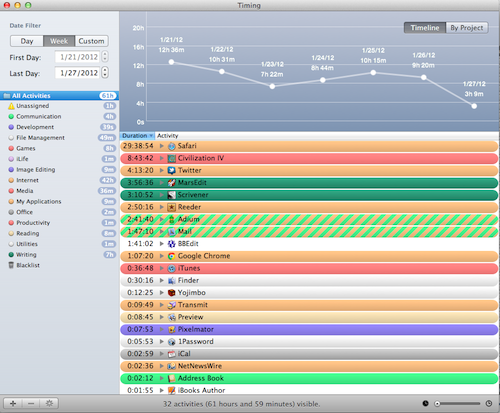
This is not going to be the beautiful and pithy psychological investigation of the truism “Timing is everything” and it’s certainly not a treatise on the secret to comedy. No, this is a quick paean to the Mac app Timing. Timing keeps track of how long you spend every day in each application you have running. It only shows you how long you’ve spent actively in a particular application. Merely having the application open doesn’t add to the time total; no, you have to actually be using it.

This is both good and bad.


Timing can also show you specifically where you’re spending the time too. Kind of scary to see the three most popular applications I’ve used int he past week are Safari, Civilization IV, and Twitter.

All weekly

Everything during the past week

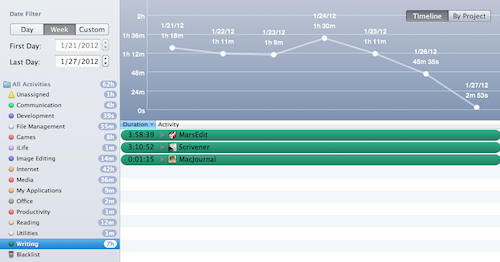
But what if I want to see how I’ve done specifically with my writing? I created a Group called “Writing” and put all of the applications I consider part of my writing into it. So let’s peek at that:

Writing week

Writing – this past week

Yeah. Kinda had a bad drop off there during the past few days. But it’s been better throughout January, right?

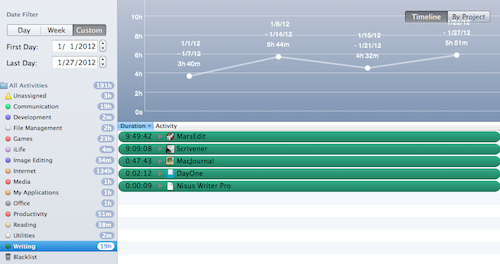
Writing month

Writing – all of January

I didn’t get so much done while I was in Hawaii, and it’s neck and neck with the time I’m spending in MarsEdit writing blog entries. I actually have done okay, writing-wise, throughout this month. (You’ll notice a couple of apps don’t show up in the weekly view but do in the monthly: yes, that’s because I didn’t use them at all in the past week. Also a good way to track whether or not you’re using those must-have apps.)

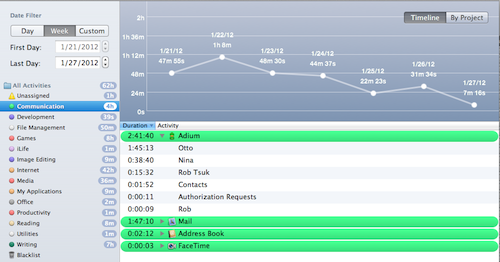
But I haven’t been wasting my time doing other stuff, have I?

Chat week

Too much chatting

Okay, so…yeah, I probably need to use my MacFreedom app a little more heavily at this point and stop chatting.

Anyhow — I don’t check Timing every day, but I find it really, really useful when I want to see how I’m doing at keeping control of my computer time.


Read More

First Lego League

Jan 15

Both kids are doing First Lego League this year. Of course, they are on different teams (sigh) and going to different championship rounds (each round being a full-day commitment so MEGA-sigh). Our local organization is the Northern California Lego League; I’m sure you can find yours on the general FLL site.

It’s a really cool program. FLL was created to introduce kids to how fun and interesting science and technology can be through the gateway drug of Lego. Teams have an adult coordinator and sometimes a teenager helping out, but the kids have to do all the programming, all the project design, etc. There are three parts to the competition:

  1. The robot game: What catches everybody’s eye with this tournament. The kids learn how to program a Lego robot to run around a game board and do various tasks, all within two minutes thirty seconds.
  2. The project: The kids do research on the theme of that year’s FLL Competition and then present their findings to a panel of judges, whether through a skit or some other way of presenting it. All of the team members need to participate in this section, so it can’t just be one or two kids who enjoy talking.
  3. The FLL Core Values: the driving force behind FLL is not just “science and tech are great” but “What’s this all about, anyhow?” The kids have to learn the core values and be able to discuss them intelligently with judges.

Every year there’s a real-world theme to the whole competition: this year’s is called “Food Factor” and it’s about food safety and contamination. Sophia’s team did a field trip to a sushi restaurant, to the middle school’s cafeteria, and to a local butcher’s shop to learn about food handling practices and concerns. Both kids’s teams came up with pretty cool real-world products (Simon’s team’s product is so cool I’m trying to talk the other families into doing a Kickstarter for it, but so far no takers).

Because the kids have to figure out how to program the robots and have to design the project and then present everything to judges, it’s really clear right away which kids have done the work and which had the adults doing the work for them. It does no good for adults to do the work (something I wish some parents at the kids’s schools would learn, SIGH), and one thing you learn right away is that these kids can do it. They might not do it well. They might not do it professionally. But man, some of these kids are amazing. (One kid on Sophia’s team was so into getting his robot to do its run correctly he worked in the basement of the team leader’s house for 4 hours on his own one night.) And if they’re not good at one thing (programming) they might be good at another (video editing).

This program is getting so popular several schools around us have FLL classes, with a teacher and all of last year’s Lego tools and lots of experience. These kids are well-taught and have great resources and are kicking our kids’s asses in the competitions. Both Simon and Sophia’s teams advanced in the first round, back in November, but I’m expecting both to get smoked in this coming round. (This isn’t just me; the other parents I’ve talked to feel the same way.) It’s like pickup teams facing the Yankees; of course the pickup teams have a chance.

If your kids are at all interested in science, technology, computers, robots, or Lego, and they’re between the ages of 9 and 14 (US/Canada/Mexico; 9 and 16 elsewhere, I guess), check it out. It will help you a lot if you can get people who’ve done it before involved, because for a newbie parent like me much of what was going on was baffling.

Read More

Organizing my note-taking life

Jan 10

I never got Notes syncing working between my Mac and my iPhone. To the best of my knowledge, no one ever has. Notes on iPhone wasn’t great anyhow: Marker Felt? Seriously?

But I’m always taking notes. Things to keep track of, lists of restaurants I might want to hit in Paris, various phone numbers and info I might need to access quickly. General note taking stuff. I keep my shopping list in a different set up (Splash Shopper). To Do (aka, the world of GTD) is in other apps.

Option 1: Notational Velocity (Mac) and SimpleNote (iOS)

This is the combo I’ve been using for a while. I think it was probably the one recommended by John Gruber of Daring Fireball.

Pros:

  1. I already have it set up.
  2. I already know how it works.
  3. It works seamlessly.

Cons:

  1. Notational Velocity is just a list of notes. There’s no hierarchy, no organization. It’s just a notepad! I could tag every note or something to organize them better but…I’ve found no really simple way of doing it, and I now have about 100 notes, most of which I haven’t looked at in a long time.
  2. It’s easier to see how notes are grouped in SimpleNote, but only if I have every note tagged (I can look at a list of tags). If I don’t, I can’t find the notes I’m looking for that way.
  3. NV has no easy way to create a new note. Sometimes I just want to create a new note and start typing. I haven’t found the “New Note” capability. I can easily “Paste as New Note…” but I don’t always want to have to paste something to get started. I just want to type. I have often gone over to SN, created a new note there, and had it sync back to NV so I could type the info in via my Mac.
  4. When you create a new note in NV, the first line of the note becomes the name of the note. Changing the name of the note is not immediately obvious. (You don’t do it in the note itself. Even if you change the first line of the note, the name remains what it was when it was created. You have to go up to the list of notes to change it.)
  5. Syncing happens through SimpleNote’s site, and I think I paid a yearly fee for that. Possibly this fee was merely to remove ads, because I am all about no ads on either machine.

Option 2: Evernote

This is the one it seems like everyone uses. Nina told me she loves it and uses it for everything, although she said it’s “more useful for long term notes rather than just short term lists”

Pros:

  1. The Mac and iOS versions are both very good-looking. Yes, style counts.
  2. Hierarchical organization is simple on both versions.
  3. Syncing appears to be instantaneous.

Cons:

  1. The ability to access your notes while offline–say, while on a plane–is only available to premium subscribers ($45/year). I don’t doubt that Evernote needs to make money, and being able to use your notes anytime you want to is a pretty killer feature.
  2. After Con #1, does there need to be a #2? I haven’t used it enough to see about more cons. I don’t want to get really involved, unless the whole shebang is so awesome I need to double-down.

Option 3: Any straight text editor (Mac) and WriteRoom (iOS)

By “straight text editor,” I speak not of its sexuality (what any editor–text, human, whatever–does on its own time is its own business) but an editor that just handles text. Default save is to a .txt file. Not a word processor illed with the funky stylistic goodness. No, an editor that just does text: BBEdit, TextWrangler, TextEdit, or even WriteRoom for Mac (which has the advantage of being a full-screen, dedicated writing environment).

WriteRoom for iOS ($5, universal) is a gorgeous app, very easy to use, and has easy organization. The free version is called PlainText.

Pros:

  1. I really like the way WriteRoom on iOS looks and feels. Very simple, yet still elegant.
  2. I have several dedicated text editors on my Mac already.
  3. Syncing via DropBox is relatively easy. (I had a terrible time getting it set up, when I’ve never had a problem before with DropBox…and then suddenly the whole thing worked. No idea what happened there.)

Cons:

  1. All these various combinations and possibilities… Is this the best combination of applications and apps? I don’t want to get invested in a new setup only to  move to something else.
  2. There’s no way to sort other than the folder hierarchy — no tags or categories or anything like that.
  3. Syncing via DropBox: the whole kerfuffle last year over DropBox’s change in its TOS makes me nervous about it. I wish more apps offered an iCloud alternative. I wish iCloud were better enough that it was a reasonable alternative.

So. Those are the three list making setups I’m considering at the moment. Any suggestions for better setups? To head off the obvious: No, I’m not going to use whatever “notes” setup Google offers. We don’t have to get into it here, but…that’s not happening. I also need app setups I can use offline.

* * *

I also need to straighten out keeping a journal and keeping a list on the computer/iPhone setup too, but I’ll save those for future posts.

Read More

Kindle vs. iBooks redux, or Amazon is making me mad

Dec 28

Kindle vs. iBooks redux, or Amazon is making me mad

I’ve been a customer of Amazon since 1995 or 1996. (I can’t get into my Quicken database right now–thank you, Intuit, for your complete abandonment of the Macintosh platform, just as it’s, y’know, exploding–but I can find out if I really need to. Do I really need to?) I had all of the initial “Thank you for being our customer!” travel mugs–remember those? I have an Amazon credit card that gives me points back on purchases. I used to tell my sister that if I could, I would buy my groceries from them. (This was before you could, in fact, buy many of your groceries from them.)

I’ve run into a few things lately that make me say, Are you kidding? Are you trying to get rid of me as a customer?

I’ve been wondering if it might be worth switching over to an airline points card, to be honest.

I have a physical Kindle–the Kindle 3, in case that makes a difference. And I have an iPad. I have read books on both. I still think the reading experience is pretty much a wash, frankly. (And now that iBooks has a night-time reading mode of white text on a black background, I’d say reading on the iPad is slightly better than the Kindle.) However, with an extra year-plus of use of both devices under my belt, I have many, many more things to say about the pros and cons of the Kindle device, the Kindle app/ecosystem, and iBooks.

Problem #1: Figure Out Collections, People

I’m guessing the problem here is that the engineers who are designing these things don’t actually read books or something. I don’t know. I have a Kindle collection of (drum roll, please) 711 items. I am always checking the Kindle bestsellers page to see what’s hot…particularly on the Free Bestseller lists. You can learn a lot about how to go about marketing a self-published book from this page, writers. Anyhow, visits to the have inspired me to download a crapload of books.

Yes, my Unread folder is insane. It’s like a To Be Read pile, only it’s not taking up physical space in my house any more.

I have attempted to take control of my books by dividing them into what Amazon calls Collections. I file each book as I get it into two folders: the Unread folder (because, duh, haven’t read it yet) and a genre folder that I created (Romance, SF, Mystery, whatever). Strangely, despite having downloaded 100% of my books from Amazon, none of the books have genre tags attached to them, so I have to investigate what the book and figure out where it goes. After I read a book, I delete it from the Unread folder.

Kindle screenshot

I’ve done this with seven hundred and eleven books. (Maybe less about 15, because I haven’t sorted those yet.) Once, back around when I had a mere 300 books, my Kindle sneezed and lost all of my Collections. I didn’t lose the books, just the way they were organized. There was some way that I could get all of my Collections back without much effort on my part, but how to do that was not at all obvious (and using an application like Calibre is an exercise in the lovable world of Open Source No Thank You), so I ended up refiling every single one again. If I lose my Collections again, I will not refile them, certainly not with 711 books, and Amazon provides no easy way of keeping these books sorted.

Even worse, however, is that the Collections do not propagate to other devices. Collections are specific to my Kindle device, not my Kindle account the road and would like to pick up with the book I’ve been reading, I have to remember the name of the book. Or the author’s name. Or something. If I’ve been reading a Regency romance novel, often all I can remember is “guy with a title blah blah feisty debutante blah Almack’s.”

Unless the book I’ve been reading has made a gigantic impression on me, I don’t remember enough about it to download it to the Kindle app on my iPhone. (Which is actually a really fabulous lesson on “How to make your novel stand out” and “What is memorable about a book.” But that’s another entry.)

On iBooks, however, having all of your books available to you is an extremely simple process:

  1. Click on the “Books” button.
  2. Add new collection name. IBooks Collections
  3. On main page, click on the “Edit” button.
  4. Select as many books as you want. (This is so damned better than Amazon’s extremely clumsy one-book-at-a-time-I’m-going-to-kill-myself-with-boredom method.) Selecting multiple iBooks
  5. Click on the “Move” button.
  6. Choose new collection to move them to.

The problem with Collections becomes really obvious on Kindle if you have more than ten books. For one thing, it takes forever to sort them into their folders. (Like I said, if I ever lose the Collections on those 711 books again…yeah, that’s it, I’m done.) The only useful thing is that the last book opened is the book at the top of the list, so it’s pretty easy to find what you’ve been reading.

On iBooks you can sort by cover art or in a list (where you can sort by Titles, Authors, or Categories, which are the genre assigned to the book, either by the iBooks store or by you, the user, in the Info field).

A list of iBooks

If you sort by cover art, of course, the last book opened is the first one on the bookshelves, so you always know what the last book you had open was.

IBooks Shelves

Advantage: iBooks. No question. Hands down.

Problem #2: Loaning Books

This is the one frustrating the hell out of me this week.

The first books I bought for my Kindle device were the Hunger Games trilogy. Sophia is old enough to read them and wanted to, which I was fine with. Not so fine: her seeing the other books in my Kindle collection. Instead, I loaned her the book so she could read it on her iOS device.

Today she asked me to reloan her Mockingjay.

According to my Kindle, it was still on loan.

Kindle On Loan

According to the “Manage Your Kindle” page on Amazon, I didn’t own it at all. (Of course, I’ve never found any of the Hunger Games books through this page, so no big deal.)

Manage Your Kindle

On an Amazon page for a book I’ve already bought, I usually get this message:

Loan This Book

Mockingjay did not give me that line about “Loan This Book.”

I couldn’t access Mockingjay on my Kindle, and I couldn’t loan it to my daughter. Effectively, I no longer owned the book.

I had to send a message to Amazon–and WOW is their Help page of no help whatsoever! I got a maze of twisty little popup menus, none of which applied to my situation–and their service rep reset the Loaned bit assigned to Mockingjay by hand. Their email responding to my inquiry was of no help whatsoever (“1. Please check and make sure the device is fully charged.”) and I gave their “Rate This Response” a low rating.

If the only way to access my own damn book is through your Customer Service rep? This rates: NOT GOOD.

Contrast this with loaning a book via iBooks. Now, admittedly, iBooks does not allow you to loan a book to any old friend in the universe, and that is a major fail on their part. However, if you and your loved ones have Home Sharing enabled, you copy the book from their account into your account and sync with your device.

You are now done with the process. And everybody can read the book at the same time. The book’s not held hostage to one pair of eyes.

Advantage: iBooks. Is there a question about this?

Problem #3: Finding New Books

There’s no question about this: Amazon’s store is so much better than just about any other shopping experience out there. And the “Customers Who Bought This Item Also Bought” feature is useful.

Browsing the iBooks store in iTunes is just…annoying.

Advantage: Kindle. This design fail is so spectacular on Apple’s part that I wonder what in the hell is going on over there and, no, I don’t have someone I can ask.

Neither online bookstore is as good as wandering around a good bookstore though, but I expect in the next year or two the real-world experience will disappear altogether. Despite not buying very many books on paper these days, I am actually upset about this.

Problem #4: Keeping Your Place In A Book

If I do manage to load a book onto my Kindle device and into my Kindle app on my iPad, the Kindle’s Whispersync method of making sure that you’re always on the same page works great.

Until I finish the damn book. Because if I decide to read it again, the Kindle system always thinks I’m on the last page if I open it on the other device. Thereby losing my place.

It’s extremely irritating.

My friend Nina and her husband share one Kindle account (so they don’t have to go through the annoyances of loaning a book, see above). Theoretically, they should be able to read the same book at the same time, but if someone finished it first, they both finish it. At this point, they have to use bookmarks to individually mark their places, and woe to them who forgets to adjust the placement of their bookmark.

Advantage: iBooks. If I start a book over, it puts me on that page no matter what device I’m using. And sharing books is much, much easier.

Problem #5: Turning the page

The biggest problem I’ve had reading on my iPad in bed is that my right hand gets tired having to be the one tapping the screen to turn the page forward. I can’t switch off between hands. The Kindle device has buttons on both sides that allow you to advance or go back.

Advantage: The Kindle, but only the Kindles with physical buttons. I’m pretty sure I’d have the same problem with the Kindle Touch. The Kindle wins for being lighter (except if, as in my case, it has a heavy leather case on it) and for having go-forward/go-back buttons on both sides.

Problem #6: Losing Your Device

Losing my Kindle would be a total bummer. However, it’s $100, which as electronic gadgets go is not a terrible loss, and if I wanted to replace it with one of these new Kindles and didn’t mind getting ads thrown at me, I could replace it for $80.

Losing my iPad would be a severe bummer, to the point where the iPad stays at home except when taken with in a special bag and watched carefully.

Advantage: Kindle. Because it’s a cheap piece of replaceable plastic crap.

I keep hearing that iBooks has got to step up its game, and I don’t see it that way at all. Slowly but surely, I’m moving my book collection to iBooks. I wish their selection were better, but it is improving all the time.


Read More

Important lessons learned from a power outage

Sep 07

If a tree falls in a forest, probably nobody except conservationists care very much. If a gigantic, century-old (or more) tree suddenly has one of its tree-sized branches fall off and block an entire street and take the power out with it, lots of people care. Yesterday this happened around the corner from us. It was fascinating to walk over there and see this massive piece of a tree lying in the middle of the street—and the even more massive tree it used to be a part of still looming over the street. I tried not to think about my kids walking past that tree every day on the way to school, or the fact that I had driven by it about 10 minutes before it fell.

Anyhow, this branch falling knocked out the power at our house from 2:50pm to 1:30am. And it was just the few houses around ours: houses a block away had power. The PG&E guys were working on the power lines the whole time (including at 11pm, Right Outside Our Window) and I don’t know who they had with chainsaws in the middle of the night cutting up that tree. I couldn’t sleep (what with PG&E guys right outside our window and chainsaws going nonstop half a block away) so I got up and went to my computer.

Darin gave me a 13-inch Macbook Air for my birthday this month and this is by far the best Macintosh laptop I’ve ever had. Holy God, is it great. It’s as fast (or maybe somewhat faster) than my 2009 Macbook Pro. It’s so light that I walk around the house carrying it with one hand. I’m sincerely annoyed by Intuit’s refusal to update Quicken for Mac, so my financial software life is somewhat in flux, but in all other aspects the Macbook Air completely and totally rocks. And it helped me learn two very important lessons.

Lesson 1

Despite the power having gone out at 2:50pm, the Air still had 90% battery life when I opened it up at 11pm. I read a friend’s new book, I worked a little bit on a couple of plays I’m writing, and I wrote a gigantic journal entry about all the things that were bugging me (and doing their part to keep me awake). At 1am or whenever I went upstairs, I had about 70% battery. This thing has amazing battery life. I’d kind of been aware of it before (certainly had better battery life than my Macbook Pro, which seemed more interested in seeing if it could make batteries bulge than in using them for a long time), but last night completely amazed me.

Lesson 2

I am never moving to an Internet-based computer like a Chromebook. There are tons of reasons not to use a Chromebook already, but if my computer had been Internet-based, it would have been a paperweight last night. I know they’re talking about making web-based devices that have locally-based applications so you can still use them when you don’t have Internet access, but in that case, why not get a computer that functions that way all of the time?

If you’ve written an application and your only help for it is an online page, let it be known that I find that very annoying. Particularly at midnight, when I’m cranky.

Lesson 3

The ice in the freezer was still loose when I checked it this morning. The very bottom layer was more molded together, but I could have easily filled several glasses with ice. Our refrigerator did a very good job of holding in the cold while the power was out.

Read More

Simple Still Isn’t Easy

May 23

Amazon decided to advertise its new Cloud Drive for music (Did I miss something? It’s a big network storage thing, right? Why is this so much more awesome than any other way of uploading my files somewhere?) by selling Lady Gaga’s new album for $0.99 today. That’s right, you can buy “Born This Way” for $0.99 at Amazon or for $15.99 at iTunes. No brainer, amirite?

Holy. Jee. Zus.

I bought the album on Amazon. The Amazon MP3 Downloader started up and told me it’s downloading the album…without filling in the bar that tells me how much it’s downloaded. I guess it downloaded one song, but on the very next song it said: “Download failed; retry download.”

Um. Okay. How do I do that?

There is no handy “Retry” button in the toolbar. There is no “Retry” menu option. I opened the Amazon MP3 Downloader help file and searched for “retry”: the word doesn’t appear anywhere in the help.

I have no idea why it’s not downloading my album. I don’t know where to go to retry or to restart this process. The choice in the toolbar is “Pause Download”, which I don’t want to do — I want it to finish the damn download.

On the next couple of songs, I’m getting the error message “Can’t connect. Check your Internet connection and retry download.” I know perfectly well my Internet connection is just fine. And I have downloaded music for Amazon before, so I have no idea: has something changed and I’ve forgotten to push some button? Are their servers getting slammed with purchases and the only available error messages blame me, the user, for their services faults?

I’m not a naive user of computers. I know plenty about how to use them. But how much energy do I want to invest in learning every single method of how to do things, especially when there are already incredibly intuitive ways that are standard on the Mac OS? That Amazon has chosen not to do this, has in fact made it hard for me, speaks volumes. They definitely have the book download process sussed out, but they have ways to go on building a media empire.

If I had given $16 to Apple, I would have my damn album already.

(In addition, it turned out that initially I had an old version of the Amazon MP3 Downloader. Um, okay. It asks me if I want to update and I say yes…and I get kicked over to an Amazon web page, where I need to click another button to download a whole ‘nother installer, which will then update my application. This is not how Mac applications do it, guys. You hit a button, and it all magically happens in the background. I don’t have to pay attention to web pages or get extra buttons. This has been a deeply frustrating experience.)

Read More